Speaker cable

Page 10 - Seeking answers? Join the What HiFi community: the world's leading independent guide to buying and owning hi-fi and home entertainment products.
Sure, sure, whatever you say.
I’m not ever going to say that cables make a huge difference

However if you’ve got a very revealing system then I believe you can hear the difference between different interconnects and speaker cables

As mentioned I used to own TQ Ultra Black speaker cable and in my system at the time, which was very revealing, I could hear the difference

Would I use TQ Ultra Black now? No I wouldn’t. I now use NACA5 because it seems to work quite well with my Naim amp without spending a fortune

The NACA5 cost me about £350, professionally made, which I considered to be fair value as it will last me a lifetime
 
Well if you’ve never had a revealing system then you won’t know what one sounds like… simple stuff really
A revealing system is what is used in studios which shows up everything warts and all, and so is nothing special as that's how every system should be, but never will be as most people hate a warts an all system and usually prefer a system that sounds nice.

Bill
 
I’m not ever going to say that cables make a huge difference

However if you’ve got a very revealing system then I believe you can hear the difference between different interconnects and speaker cables

As mentioned I used to own TQ Ultra Black speaker cable and in my system at the time, which was very revealing, I could hear the difference

Would I use TQ Ultra Black now? No I wouldn’t. I now use NACA5 because it seems to work quite well with my Naim amp without spending a fortune

The NACA5 cost me about £350, professionally made, which I considered to be fair value as it will last me a lifetime
You can't. You can show scientifically that you can't. Differences you are hearing are psychological.
 
  • Like
Reactions: Dave_
A revealing system is what is used in studios which shows up everything warts and all, and so is nothing special as that's how every system should be, but never will be as most people hate a warts an all system and usually prefer a system that sounds nice.

Bill
You can easily have a system as revealing as in the studio. The thing is if the studio is using standard cables then how are the details that the special audiophile cables allow through going to be there in the first place? 😀
 
  • Like
Reactions: Dave_
You can easily have a system as revealing as in the studio. The thing is if the studio is using standard cables then how are the details that the special audiophile cables allow through going to be there in the first place? 😀
That’s true Topping you could

I’ve certainly owned a very revealing system in the past
 
You can easily have a system as revealing as in the studio. The thing is if the studio is using standard cables then how are the details that the special audiophile cables allow through going to be there in the first place? 😀
The only cables in the recording path in a studio will be balanced from mic to mixing desk.

Studio monitoring systems are chosen mostly for their balance, rather than outright quality. Any studio's job is just to get the music recorded, which is captured to whatever format from the instrument to the mixing desk - that signal doesn't touch a "system" in the conventional sense - it's only monitored via a system (usually active monitors, usually chosen for ease of use) - less boxes/cabling etc. Those who master albums will have their preferred equipment (not necessarily a studio system) - like Bob Ludwig using Eggleston Works loudspeakers. Again, not in the signal path, but they allow the masterer to hear everything that was captured and to preserve/polish etc.
 
The only cables in the recording path in a studio will be balanced from mic to mixing desk.

Studio monitoring systems are chosen mostly for their balance, rather than outright quality. Any studio's job is just to get the music recorded, which is captured to whatever format from the instrument to the mixing desk - that signal doesn't touch a "system" in the conventional sense - it's only monitored via a system (usually active monitors, usually chosen for ease of use) - less boxes/cabling etc. Those who master albums will have their preferred equipment (not necessarily a studio system) - like Bob Ludwig using Eggleston Works loudspeakers. Again, not in the signal path, but they allow the masterer to hear everything that was captured and to preerve/polish etc.
Yes but what's your point? They use balanced because typically they will be quite long runs and there can be many sources of interference in a studio. Other than that, how are audiophile cables going to pull more detail out than was already there? It's impossible. I mean, you can use balanced cables at home if you're concerned about interference. They won't drag out more detail either, though.
 
I appreciate this is about speaker cables but here's a nice spin on headphone cables from Wave Theory; even if you don't sit on the cables make a difference camp, you got to admire the different variations and choice that's available to the consumer.

When choosing a cable, I also consider the quality of the XLR/Jack plugs, such as Rean, Amphenol, Neutrik, Switchcraft, top end Furutech very nice. I have preference for starquad soldering you see typically with Japanese Mogami and Swiss Gotham cables.

View: https://youtu.be/56oqcgZDRHE?si=Bx85HFSN4b8xfkwh

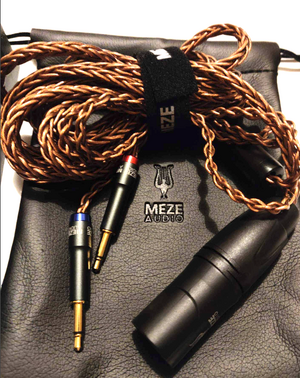
I was going to go for the Artic, I placed it in my shopping cart, then I was swayed by the Caesar until I came across the Meze FURUKAWA Single Crystal Copper, which is almost identical to the Artic, aesthetically pleasing - Artic has square weaving, the Meze loop weaving - below. The reviews were most encouraging, so I decided on the Meze.

View: https://youtu.be/KIYnNyAaL5E?si=KbCX4JWwcWK6XRYH


1776693321719.png
 
Last edited:
The ABX blind testing that finds no one can reliably tell the difference and this test, should end the cable debate;


"The Kimber KS 1036 ($4520 for the pair, 1 meter) has identical electrical performance as my ultra cheap (but well built) Amazon cables. Testing was performed way outside of audible range and still no difference was found."

If various tests fail to find a measurable difference, then no one can possibly hear an actual difference. If people are sure they can hear a difference, then they need to look at their ears and brain, to explain why there is a difference, as it is not the cable itself.

 
The ABX blind testing that finds no one can reliably tell the difference and this test, should end the cable debate;


"The Kimber KS 1036 ($4520 for the pair, 1 meter) has identical electrical performance as my ultra cheap (but well built) Amazon cables. Testing was performed way outside of audible range and still no difference was found."

If various tests fail to find a measurable difference, then no one can possibly hear an actual difference. If people are sure they can hear a difference, then they need to look at their ears and brain, to explain why there is a difference, as it is not the cable itself.

Yeah but cryo treated copper conductors!
 
  • Like
Reactions: Jasonovich

TRENDING THREADS