







Any 2-4mm squared pure copper cable should be good enough for @good_enough 😉Chicken feed.
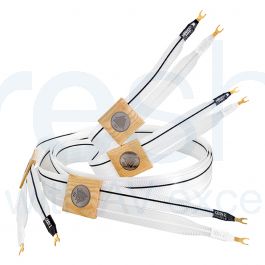
Nordost Odin 2 Speaker Cable - Factory Terminated Pair
Nordost's Odin 2 range is the 'Supreme Reference' for top-of-the-range audiophile equipment. Each component of the Odin 2 range is meticulously crafted to ensure the most performance out of your system. The Odin 2 Speaker cable is designed to ensure the purest audio signal transfer to your...www.futureshop.co.uk

Speaker cable
Page 2 - Seeking answers? Join the What HiFi community: the world's leading independent guide to buying and owning hi-fi and home entertainment products.
You are using an out of date browser. It may not display this or other websites correctly.
You should upgrade or use an alternative browser.
You should upgrade or use an alternative browser.

good_enough
Well-known member
- Mar 12, 2016
- 235
- 181
- 18,970














You have me bang to rights.Any 2-4mm squared pure copper cable should be good enough for @good_enough 😉

MUSICRAFT
Well-known member
- Mar 23, 2009
- 3,058
- 1,234
- 22,570







Hello,
Recently acquired a pair B&W 705 Signature speakers (in fabulous datuk finish) and the Rotel RA-1592MKII integrated amplifier.
Now i am looking for speakercables ( bi-wire or full-range with jumper) that would bring the most out of them.
I am thinking about : or ??
Thanks for any advice you can give me
Fwiw, our current store system partly consists of a pair of Michi M8's and a pair of Acoustic Energy AE520's. Speaker cables are basic 500 strand full range btw. If these cables are also good enough for Rotel's best amplification to date then they will be more than good enough for the RA-1592 MK and 705 Signature's.

record_spot
Well-known member
- May 30, 2015
- 759
- 658
- 19,770
Mission 751s with QED XT. Think they were about £40 for a 3m pair (discounted stock, so you'd pay more for those normally). They were pre-terminated which saved me a job.

Classic.
Fwiw I went with qed 79 strand to hide in the walls with my current setup. I’ve got some old chord rumour kicking around that’s too short but I can’t really tell the difference.

davidf
Well-known member
- May 9, 2017
- 2,045
- 1,981
- 23,070

Why do you believe that? Our hearing is an extremely complex thing, and I feel the capabilities of our hearing is massively underplayed by those that would have you believe it is.Human hearing is really not all that great.
davidf
Well-known member
- May 9, 2017
- 2,045
- 1,981
- 23,070
I've never been a fan of QED cables.Qed silver anniversary xt + silver micro does and micro lacks bass it's thin sounding as i remember
davidf
Well-known member
- May 9, 2017
- 2,045
- 1,981
- 23,070
It's all about personal opinion. Personally, I'm not keen on huge strand counts, based on my personal experiences.Fwiw, our current store system partly consists of a pair of Michi M8's and a pair of Acoustic Energy AE520's. Speaker cables are basic 500 strand full range btw. If these cables are also good enough for Rotel's best amplification to date then they will be more than good enough for the RA-1592 MK and 705 Signature's.

Revolutions
Well-known member
- Aug 6, 2023
- 1,253
- 1,750
- 5,570
I never said hearing wasn’t complex. Compared to other mammals, our hearing range & sensitivity is pretty poor. That’s just a physiological fact. We cannot hear the frequencies we cannot hear.Why do you believe that? Our hearing is an extremely complex thing, and I feel the capabilities of our hearing is massively underplayed by those that would have you believe it is.
Beyond that, how our brains process data makes humans unreliable witnesses. aka psychoacoustics (as you mentioned already: people who want to hear a difference will hear a difference).
How do you mean that hearing is underplayed- who is doing it, and to what end?
GroeneLeeuw
Well-known member
- Nov 4, 2019
- 186
- 188
- 10,770
It´s not your hearing that is complex, it´s your brain!Why do you believe that? Our hearing is an extremely complex thing, and I feel the capabilities of our hearing is massively underplayed by those that would have you believe it is.
Do you know when I experience big sound differences? If my mood changes.
Some days, I´m in a good mood and really into listening to music (or a specific piece of music) and it sounds fantastic. A few days later, I try to relive the experience, llisten to the exact same music but, somehow, it doesn´t happen. It sounds different, it doesn´t make feel the same, it doesn´t sound as good.
My set is not emotional.
How could it be? It´s a combination of machines and objects that are designed to work in a certain way and do that always (minus technical issues/defects).
Me, on the other hand, am an emotional being. I don´t function the same everyday, don´t feel the same everyday.
I like Qed xt25 in my system (also over micca cable), if there any with better synergy i don't knowI've never been a fan of QED cables.
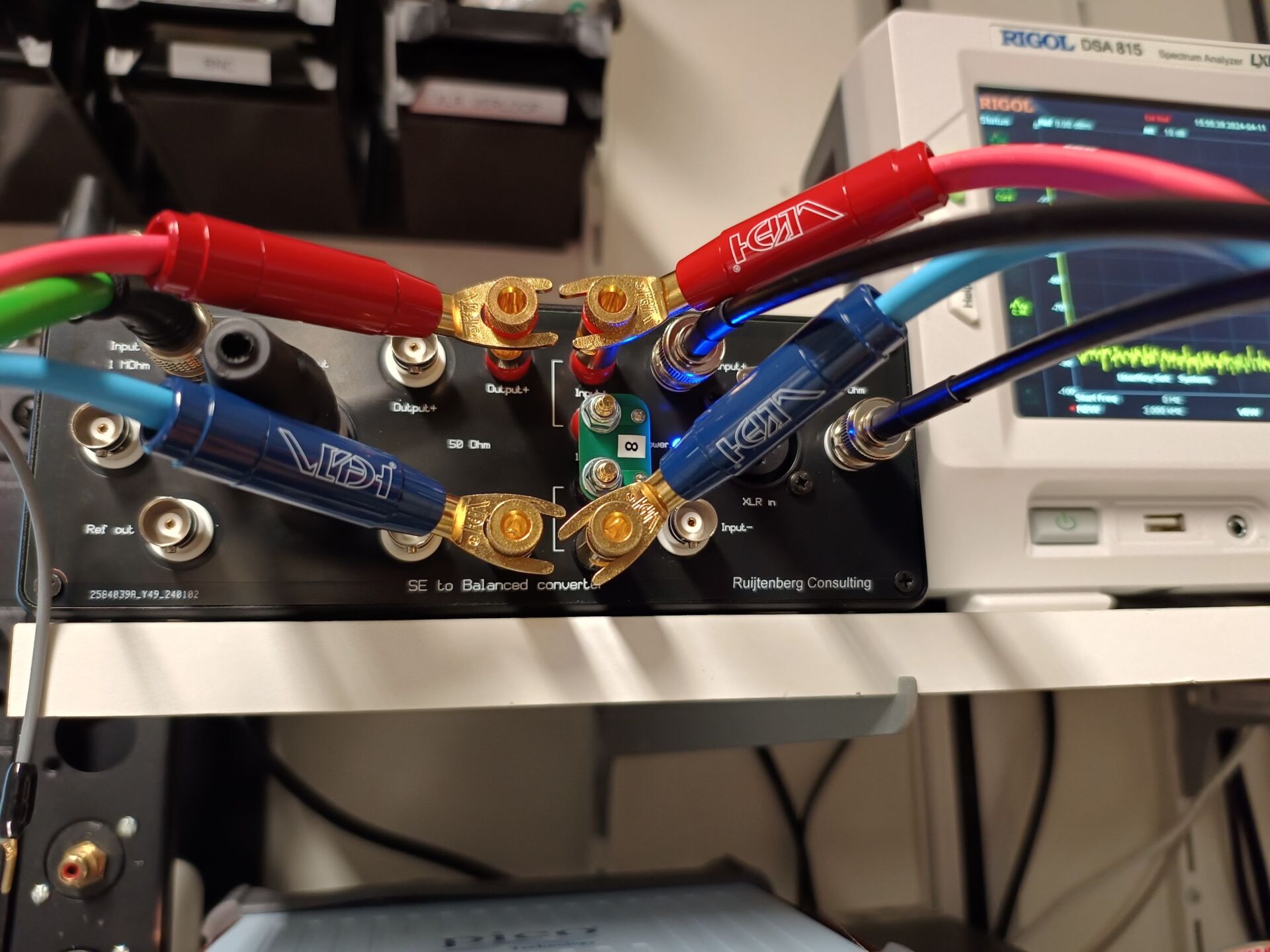
Megatest speaker cables – 32 cables listened to and measured!
Following the mega interlink test, we also measured and listened to 32 speaker cables. This to determine whether certain elements we hear are also measurable. T
 www.alpha-audio.net
Last edited:

abacus
Well-known member
- Sep 24, 2008
- 1,728
- 1,701
- 23,070
That's going back a bit, I remember the test well, it also confirmed that expensive cable were a con and that a good quality cable that was reasonably priced was all that was needed.I like Qed xt25 in my system (also over micca cable), if there any with better synergy i don't know
Megatest speaker cables – 32 cables listened to and measured!
Following the mega interlink test, we also measured and listened to 32 speaker cables. This to determine whether certain elements we hear are also measurable. T
Remember a cable should be totally neutral, if it alters the sound in any way then it is of poor quality, which is one thing manufactures mean when they say how their cables alter the sound. (They just explain it in a way that sounds good when in actual fact it is bad)
Bill
abacus
Well-known member
- Sep 24, 2008
- 1,728
- 1,701
- 23,070
The senses of biological life forms are easily fooled, this is the reason all external ques have to be removed to get an accurate result. (10 individuals is a bare minimum for a basic test, but you need at least 100 to make the test really relevant (The more people you have the more accurate the results)Why do you believe that? Our hearing is an extremely complex thing, and I feel the capabilities of our hearing is massively underplayed by those that would have you believe it is.
Bill

woodbar
Well-known member
- Feb 23, 2026
- 187
- 192
- 270
I remember
My experience exactly!It´s not your hearing that is complex, it´s your brain!
Do you know when I experience big sound differences? If my mood changes.
Some days, I´m in a good mood and really into listening to music (or a specific piece of music) and it sounds fantastic. A few days later, I try to relive the experience, llisten to the exact same music but, somehow, it doesn´t happen. It sounds different, it doesn´t make feel the same, it doesn´t sound as good.
My set is not emotional.
How could it be? It´s a combination of machines and objects that are designed to work in a certain way and do that always (minus technical issues/defects).
Me, on the other hand, am an emotional being. I don´t function the same everyday, don´t feel the same everyday.
davidf
Well-known member
- May 9, 2017
- 2,045
- 1,981
- 23,070
Can you measure that and show us the correlation between mood and music?It´s not your hearing that is complex, it´s your brain!
Do you know when I experience big sound differences? If my mood changes.
Some days, I´m in a good mood and really into listening to music (or a specific piece of music) and it sounds fantastic. A few days later, I try to relive the experience, llisten to the exact same music but, somehow, it doesn´t happen. It sounds different, it doesn´t make feel the same, it doesn´t sound as good.
My set is not emotional.
How could it be? It´s a combination of machines and objects that are designed to work in a certain way and do that always (minus technical issues/defects).
Me, on the other hand, am an emotional being. I don´t function the same everyday, don´t feel the same everyday.
woodbar
Well-known member
- Feb 23, 2026
- 187
- 192
- 270
Is there an objective categorisation able to define moods?Can you measure that and show us the correlation between mood and music?
Listening to music will change your mood in any case so the results would be totally variable, inconsistent and therefore worthless? 😎
GroeneLeeuw
Well-known member
- Nov 4, 2019
- 186
- 188
- 10,770
I´m not sure if moods can be measured. Maybe with a CAT scan?Can you measure that and show us the correlation between mood and music?
But cables, amplifiers, DACs, CD players, streamers?
We most certainly can! And compare results. We are able to say which piece of equipment measures better.
Science is also able to say, because we know what the max capabilities of human hearing are, what we are able to hear and if we can hear differences (minus our brains playing tricks on us).
But all that information seems to bother you.
Why is that?
That said, it doesn´t mean that people are not able to make a choice of what is it that they want to buy based on whatever subjective criteria- looks, brand reputation, features, etc.- they might have.
One of the criteria can even be that they think/are convinced that one piece of equipment sounds better than the other, even if the measurements say that is not possible.
But imagine, I´m looking to buy a product.
What is more reliable for me to take in as information as to help me make a decision on what to buy?
1- the subjective opinion of someone (a reviewer for example) or
2- precise measurements
I´ll take the measurements first. And then I´ll try to confirm with my hearing and let all my other senses also participate in the choice.
Revolutions
Well-known member
- Aug 6, 2023
- 1,253
- 1,750
- 5,570
You can get into measuring sentiment & mood using COM-B, a popular model in behavioural science.
Behaviour is an outcome of Capability, Opportunity & Motivation. Humans bring their whole lived experience into every moment of our lives. Motivation is complex & very difficult to work with at scale but systems modellers & the likes do. And of course, Marketers with budgets to hire the smartest people are pretty good at measuring attitude & converting that into some kind of action.
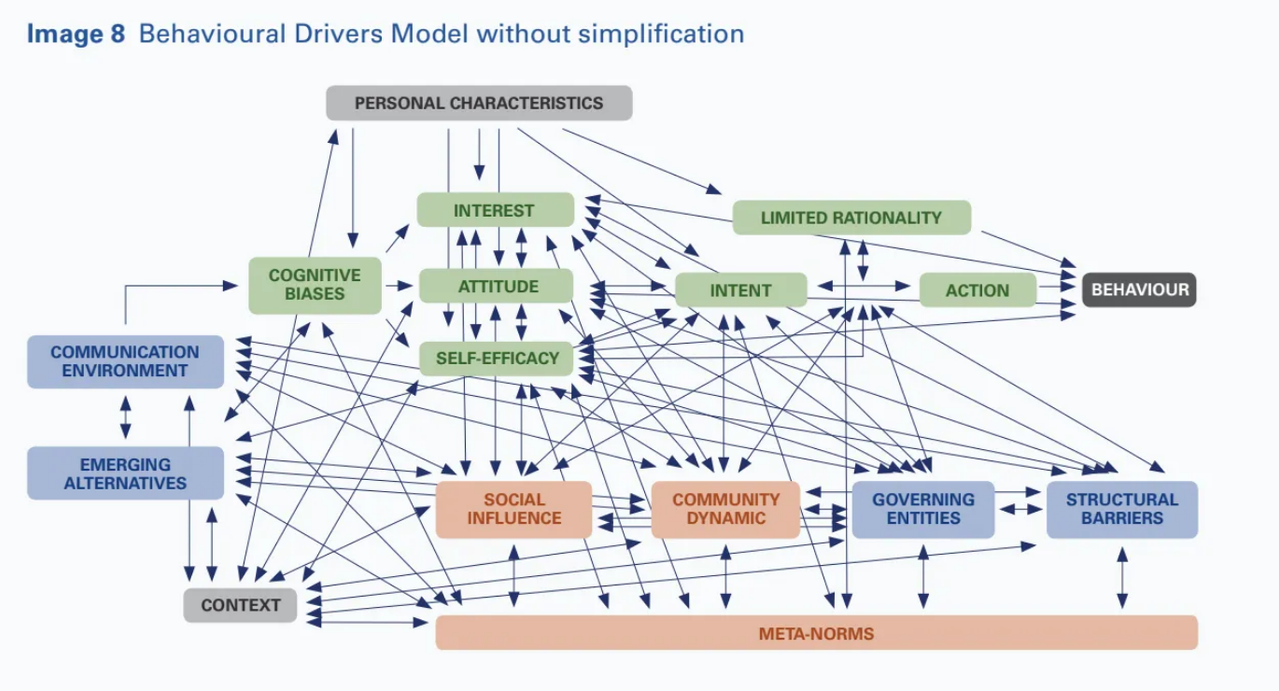
This diagram shows the volume of different types of experiences that will affect how we behave. It's not straightforward. I presume some folk on here are John Boyd fans - this is a good representation of what is going through a pilot's conciseness when trying to speed through an OODA loop.
Behaviour is an outcome of Capability, Opportunity & Motivation. Humans bring their whole lived experience into every moment of our lives. Motivation is complex & very difficult to work with at scale but systems modellers & the likes do. And of course, Marketers with budgets to hire the smartest people are pretty good at measuring attitude & converting that into some kind of action.
This diagram shows the volume of different types of experiences that will affect how we behave. It's not straightforward. I presume some folk on here are John Boyd fans - this is a good representation of what is going through a pilot's conciseness when trying to speed through an OODA loop.
Last edited:
woodbar
Well-known member
- Feb 23, 2026
- 187
- 192
- 270
Eh, just too deep for me I am afraidYou can get into measuring sentiment & mood using COM-B, a popular in behavioural science.
Behaviour is an outcome of Capability, Opportunity & Motivation. Humans bring their whole lived experience into every moment of our lives. Motivation is complex & very difficult to work with at scale but systems modellers & the likes do. And of course, Marketers with budgets to hire the smartest people are pretty good at measuring attitude & converting that into some kind of action.
This diagram shows the volume of different types of experiences that will affect how we behave. It's not straightforward. I presume some folk on here are John Boyd fans - this is a good representation of what is going through a pilot's conciseness when trying to speed through an OODA loop.
woodbar
Well-known member
- Feb 23, 2026
- 187
- 192
- 270
I would mostly agree with that part.But imagine, I´m looking to buy a product.
What is more reliable for me to take in as information as to help me make a decision on what to buy?
1- the subjective opinion of someone (a reviewer for example) or
2- precise measurements
I´ll take the measurements first. And then I´ll try to confirm with my hearing and let all my other senses also participate in the choice.
1- Check the measurements and sensible reviews to confirm there are no glaring flaws
2- Use my ears to see if I like what I hear.
3-Confirm it is aesthetically suitable for my home environment
4- When tested at home, if 2 or 3 then fail - return it, then go to 1 for an alternative
Of course, there are some of the opinion that the common measurements that are used for audio devices do not actually define the sound profile or intricacies of what is heard by some with our our ears and not others? So it may be possible that two DACs for example, measure exactly the same but sound slightly different?
Last edited:
davidf
Well-known member
- May 9, 2017
- 2,045
- 1,981
- 23,070
If you're of the camp that believes everything can be measured, more power to you. Enjoy your defined limits. There's plenty of things that science cannot measure or explain.I´m not sure if moods can be measured. Maybe with a CAT scan?
But cables, amplifiers, DACs, CD players, streamers?
We most certainly can! And compare results. We are able to say which piece of equipment measures better.
Science is also able to say, because we know what the max capabilities of human hearing are, what we are able to hear and if we can hear differences (minus our brains playing tricks on us).
But all that information seems to bother you.
Why is that?
That said, it doesn´t mean that people are not able to make a choice of what is it that they want to buy based on whatever subjective criteria- looks, brand reputation, features, etc.- they might have.
One of the criteria can even be that they think/are convinced that one piece of equipment sounds better than the other, even if the measurements say that is not possible.
But imagine, I´m looking to buy a product.
What is more reliable for me to take in as information as to help me make a decision on what to buy?
1- the subjective opinion of someone (a reviewer for example) or
2- precise measurements
I´ll take the measurements first. And then I´ll try to confirm with my hearing and let all my other senses also participate in the choice.
As for buying a product, there should be a third - listening to it yourself with your own ears, and deciding if it suits you. Relying on the measurements before you hear it will cloud your judgement - it'll tell you what you are going to hear. Listen to it, make your own mind up, then look at the measurements. If it tallies to what you heard, great. If it doesn't, does it then really matter?
GroeneLeeuw
Well-known member
- Nov 4, 2019
- 186
- 188
- 10,770
Audio equipment is not of them.There's plenty of things that science cannot measure or explain.
davidf
Well-known member
- May 9, 2017
- 2,045
- 1,981
- 23,070
woodbar
Well-known member
- Feb 23, 2026
- 187
- 192
- 270
Sort of what I said above I think - except that I would check the measurements first just to make sure it was not a "dog" with loads of distortion or limited dynamics etc.If you're of the camp that believes everything can be measured, more power to you. Enjoy your defined limits. There's plenty of things that science cannot measure or explain.
As for buying a product, there should be a third - listening to it yourself with your own ears, and deciding if it suits you. Relying on the measurements before you hear it will cloud your judgement - it'll tell you what you are going to hear. Listen to it, make your own mind up, then look at the measurements. If it tallies to what you heard, great. If it doesn't, does it then really matter?
woodbar
Well-known member
- Feb 23, 2026
- 187
- 192
- 270
I am not sure how you can confirm the unknown?Audio equipment is not of them.
Similar threads
- Replies
- 3
- Views
- 2K

- Replies
- 2
- Views
- 2K

- Replies
- 31
- Views
- 17K
TRENDING THREADS
-
Question Audio system for a small (5mx5.5m) living room in a Central London flat
- Started by rs_ldn
- Replies: 4
-

-

-

-

-
-



Space.com is part of Future plc, an international media group and leading digital publisher. Visit our corporate site.
© Future Publishing Limited Quay House, The Ambury, Bath BA1 1UA. All rights reserved. England and Wales company registration number 2008885.
 Facebook
 Twitter
 Instagram