The power output capabilities of past and present power amplifiers have been based, not on acoustic requirements, but on electro-economic considerations. Today's low-efficiency loudspeakers in a room of typical size would require several
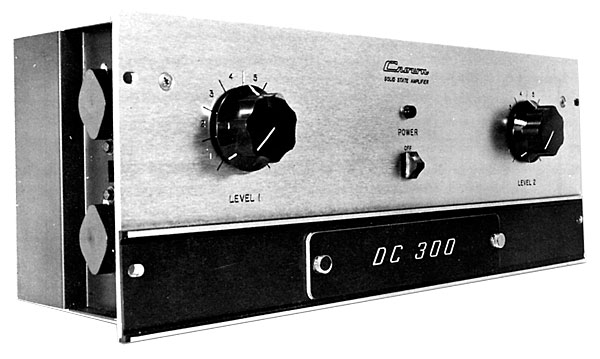
kilowatts of input power in order to produce (dissipation allowing) the greatest sound-pressure peaks that can occur in live musical performance. Clearly the larger the amplifier, other things being equal, the more faithful the sound. By delivering the maximum output power reasonably obtainable with today's semiconductor power technology, the DC-300 delivers a previously unattainable level of fidelity.
Since it is inevitable that a power amplifier smaller than several kilowatts will be overloaded from time to time when driving low-efficiency speakers at high volume, overload recovery must be instantaneous and free from subsequent thumps or distortion. The DC-300's totally DC-coupled design is unequalled in this respect.
Dynamically, the DC-300 is, as far as we know, without peer. Its ultra-low distortion required the development of an ultra-low-residual IM meter (less than 0.005%) to allow for actual measurement of distortion at levels down to 10 milliwatts output. (Harmonic analyzers are not sensitive enough.) The oommon practice of measuring IM down to no lower than 1 watt is not an adequate test for crossover notch distortion, as large amounts of IM are often produced between 10mW and 1W, while distortion above 1W is acceptably low. It is the DC-300'S extremely low distortion below 1W, plus its very low hum and noise, that make it sound so outstandingly good at low listening levels.
Incidentally, its noise is so low (typically 115dB below 150W into 8 ohms) that special voltmeters having a full-scale sensitivity of 100 microvolts had to be built in order to allow meaningful production-line testing of the amplifier.—
Crown
Read more at https://www.stereophile.com/content/crown-dc-300-power-amplifier#pdJRp51y0p40WYe9.99























 Facebook
 Twitter
 Instagram