







Question Balanced Headphone Cable

Barnaby

Well-known member
Feb 3, 2015
56
9
18,545
Hello again fellow listeners,

I have recently bought a Topping D3X Pro + DAC/Amp and am likely to keep it, however, I did notice that the Fiio K11 R2R that was also on my list sports a "4.4mm balanced out" If I was swayed into returning the Topping and getting the Fiio, I am wondering what to do about this 4.4mm output. Is there an advantage to balanced headphone outputs? I have a pair of Sennheiser HD650s.

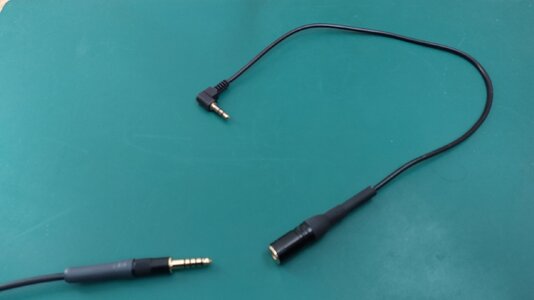
I saw a discussion on here re interconnects and speakers but nothing about this. One youtuber ( seemingly not sponsored ) was strongly recommending using a balanced out with them and said it was a vast improvement. I am now very curious. I guess I'd need to swap out the cable for a balanced one but to what advantage? That is my question.

 
I guess I'd need to swap out the cable for a balanced one but to what advantage?
Fiio spec shows that it gives more than double the power from the balanced, compared to its standard output.

But you'll likely notice a bigger (but still not massive) difference in sound between the Topping and Fiio, than you would by going between balanced and unbalanced on the Fiio (or anything else).

Best advice would be to compare the two models first if possible.
Then if you decide to go with the K11, spend no more than necessary for a balanced cable.....then experiment.
 
Yes, I currently have the Topping and I honestly don't usually like to do it, but I'm wondering about trying the Fiio and if I prefer it returning the Topping.

It's a bit naff thing to do but OTOH it is now really hard to find items to try on the High St and online retailers are reaping the rewards so I guess they might factor this sort of behaviour into their business model.

Apart from the ethical dilemma though I am perhaps going to try both out as you suggest and if I keep the Fiio then go down the route you suggested.
Thank you
 
  • Like
Reactions: Gray
A general point. Some headphones are designed for balanced connection, and they tend to be more expensive. They will have a cable to each capsule too. (Sennheiser I’ve used have two cables!) Others have a single connection, or fixed cables, and if so then balanced isn’t an option.

If your phones accept balanced then in theory you’ll get less noise. Obviously if that’s not a problem at the moment then you may not get any benefit.
 
Yes I have the HD 650 which have the removable cable fitting into both sides so should be capable. I haven't heard much in the way of noise with these so maybe not much point.
 
If your phones accept balanced then in theory you’ll get less noise.
No.
Balanced as used to connect gear at line level is a hot (the signal), a cold (the reverse of the hot) and a ground. At the receiver a differential amp compares the hot and the cold and any difference is removed. This is called common noise rejection.

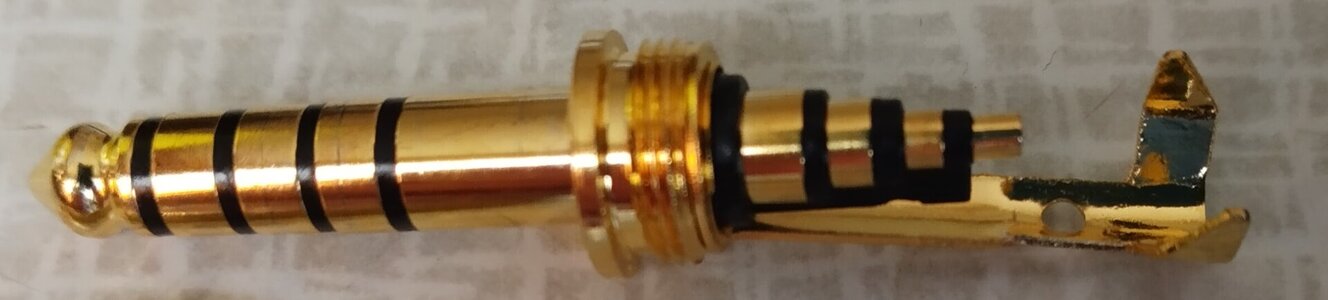
In case of a "balanced" headphone connection, you have 2 amps per channel instead of 1. One puling, one pushing. This topology is called a balanced amp. As now the "ground" has become active, you can't use a common ground any more so no TRS but TRRS. Basically 2x single ended.
Assuming identical amps, if you use 2 per channel you double the power but also the distortion and the impedance.
In theory more noise.
In practice it is all over the place. Sometimes indeed power/distortion/impedance doubles, sometimes the TRS is added as an afterthought and is even worse on distortion. Sometime a 4 pin connection is offered by the headphone amp but it is still a single amp per channel....

Anyway, as there is nothing inside a headphone comparing 2 signals, it won't do common noise rejection.
 
No.
Balanced as used to connect gear at line level is a hot (the signal), a cold (the reverse of the hot) and a ground. At the receiver a differential amp compares the hot and the cold and any difference is removed. This is called common noise rejection.

In case of a "balanced" headphone connection, you have 2 amps per channel instead of 1. One puling, one pushing. This topology is called a balanced amp. As now the "ground" has become active, you can't use a common ground any more so no TRS but TRRS. Basically 2x single ended.
Assuming identical amps, if you use 2 per channel you double the power but also the distortion and the impedance.
In theory more noise.
In practice it is all over the place. Sometimes indeed power/distortion/impedance doubles, sometimes the TRS is added as an afterthought and is even worse on distortion. Sometime a 4 pin connection is offered by the headphone amp but it is still a single amp per channel....

Anyway, as there is nothing inside a headphone comparing 2 signals, it won't do common noise rejection.
Thanks, Vincent. Your reasoning seems quite logical, and I’m happy to defer to your knowledge. I knew I was taking a bit of a risk posting this because headphones aren’t my speciality. But I did check here (link below) first, where it clearly explains how noise is reduced, hence my simplified version above.


TRENDING THREADS