• Thank you all very much for sharing your time with us in 2025. We hope you all have a safe and happy 2026!

Spotify Lossless

Page 3 - Seeking answers? Join the What HiFi community: the world's leading independent guide to buying and owning hi-fi and home entertainment products.
Obvs Spotify lossless won’t work on most systems until software updates.

FYI - on my Linn, comparing Tidal & whatever format Spotify is spitting out to the Lin Selekt DSM, listening to Prima Queen - The Prize, first by whole track, then switching between the two at specific moments to hear how it treated different textures & layers, I can proudly announce that I could hear no difference.

Of course, that’s one song from a recently released album. I might do some more testing. But probably not. I’m sort of already over Tidal’s ux in anticipation of going back to 100% Spotify for streaming.

 
My Wiims (mini and pro) needed to be restarted (power off and power on) to pick up lossless, for some reason. I've not done any serious listening but I'm not noticing an much difference.
 
Obvs Spotify lossless won’t work on most systems until software updates.

FYI - on my Linn, comparing Tidal & whatever format Spotify is spitting out to the Lin Selekt DSM, listening to Prima Queen - The Prize, first by whole track, then switching between the two at specific moments to hear how it treated different textures & layers, I can proudly announce that I could hear no difference.

Of course, that’s one song from a recently released album. I might do some more testing. But probably not. I’m sort of already over Tidal’s ux in anticipation of going back to 100% Spotify for streaming.

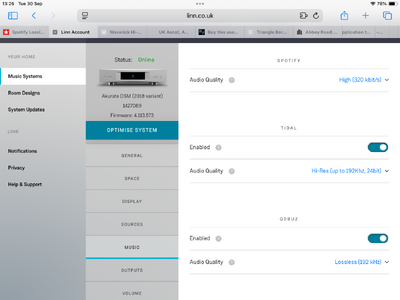
You prompted me to take a look, and in Linn’s ‘manage systems’ web page, my Akurate DSM still shows 320kbit/s for Spotify, contrasting with Tidal and Qobuz options. IMG_3604.png
 
Last edited:
  • Like
Reactions: Revolutions
You prompted my to take a look, and in Linn’s ‘manage systems’ web page, my Akurate DSM still shows 320kbit/s

Some systems need to roll out firmware. Some systems e.g. Wiim seem to require a power-off/on approach and HEOS needs you to tell Spotify to forget the device and then reconnect.

Wiim might work if you tell Spotify to log out of the device and reconnect. I did not try, I just powered off.

CCA does not support lossless.
 
Some systems need to roll out firmware. Some systems e.g. Wiim seem to require a power-off/on approach and HEOS needs you to tell Spotify to forget the device and then reconnect.

Wiim might work if you tell Spotify to log out of the device and reconnect. I did not try, I just powered off.

CCA does not support lossless.
Power cycling was my experience with my LS60s.
 
Just playing Toyah, Chameleon on my dining room hifi and yep Spotify is locked at 320Kbs through CCA.

Are you using analogue or optical out in the CCA .... from memory I think if you're using analogue it caps it but if optical it automatically goes to the highest level it can up to 24/96.
That said it could be to do with Spotify but just thought it worth mentioning in case.
 
Are you using analogue or optical out in the CCA .... from memory I think if you're using analogue it caps it but if optical it automatically goes to the highest level it can up to 24/96.
That said it could be to do with Spotify but just thought it worth mentioning in case.
I'll have a go later on the CCA in my main room, that's connected optically. The one in the dining room is connected via analogue.
 
Spotify Lossless just landed in Ireland
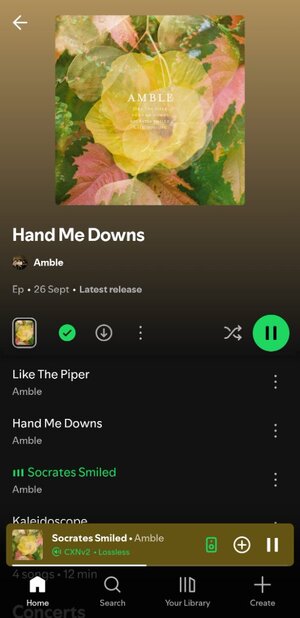
It's working fine on the Cambridge CXN V2. Had to power-cycle the streamer (off/on) for the update to kick in, but once it did -- Lossless showed up. No faff. No fuss. Sound? Noticeably fuller, tighter low-end, better texture on acoustic material.

If you're running a CXN V2, give it a reboot and dive in...👌
 

Attachments

  • 1000063289.jpg
    1000063289.jpg
    63.1 KB · Views: 3
  • Like
Reactions: manicm
I listen to Spotify via the app on my smartTV that's plugged into my amp. Can't tell the difference to be honest.
 
I haven't read or watched a single decent review of Spotify Lossless for hi-fi/speaker duty. They're mostly done on the PC, hardly any through Connect. This is significant because through Connect the stream should be bit perfect.
 
I haven't read or watched a single decent review of Spotify Lossless for hi-fi/speaker duty. They're mostly done on the PC, hardly any through Connect. This is significant because through Connect the stream should be bit perfect.
I use Connect on my streamer and it sounds extremely good.
 
  • Like
Reactions: manicm
So it's finally arrived in my region. The Premium plan has increased in price. But it doesn't include Lossless. To get the latter I need to subscribe to a so called Platinum option, which includes membership for 3.

My heart is in a dilemma. The British artist Mary Spendor has posted a video saying she's cancelled her subscription, arguing there's no corresponding increase in artist royalties.

So while I still much prefer the Spotify experience, I may stick with Tidal. But I'll still give it a try.
 
  • Like
Reactions: Jasonovich
Hi everyone, I just arrived here (new account) after reading my father-in-law's latest copy of WHF and browsing these forums.

There seems to be a lot of confusion regarding sample rates and the assumption that 'higher = better.' The reality is that for playback, you almost certainly aren't gaining any extra audible 'detail' by using sample rates higher than 44.1kHz.

This is based on the Nyquist-Shannon sampling theorem. A sample rate of 44.1kHz is mathematically sufficient to perfectly reconstruct the continuous waveform of any signal up to 22.05kHz. Since the human limit is roughly 20kHz, 44.1kHz captures everything we can biologically hear.

Contrary to the common myth, digital audio does not output 'steps' that need smoothing; the D/A conversion process recreates the exact smooth curve of the original analog wave, provided it is within that frequency limit (band limited).

Any information contained in higher sample rates is, by definition, ultrasonic. Unless you are a bat, or you intend to stretch/process the audio (where the extra data prevents aliasing during DSP), that extra data is effectively invisible to the human ear.

TLDR: Don't worry about streaming services offering 192kHz playback, etc. 44.1 is absolutely fine, and a fantastic standard 🙂
 
Last edited:
Hi everyone, I just arrived here (new account) after reading my father-in-law's latest copy of WHF and browsing these forums.

There seems to be a lot of confusion regarding sample rates and the assumption that 'higher = better.' The reality is that for playback, you almost certainly aren't gaining any extra audible 'detail' by using sample rates higher than 44.1kHz.

This is based on the Nyquist-Shannon sampling theorem. A sample rate of 44.1kHz is mathematically sufficient to perfectly reconstruct the continuous waveform of any signal up to 22.05kHz. Since the human limit is roughly 20kHz, 44.1kHz captures everything we can biologically hear.

Contrary to the common myth, digital audio does not output 'steps' that need smoothing; the D/A conversion process recreates the exact smooth curve of the original analog wave, provided it is within that frequency limit (band limited).

Any information contained in higher sample rates is, by definition, ultrasonic. Unless you are a bat, or you intend to stretch/process the audio (where the extra data prevents aliasing during DSP), that extra data is effectively invisible to the human ear.

TLDR: Don't worry about streaming services offering 192kHz playback, etc. 44.1 is absolutely fine, and a fantastic standard 🙂
Welcome to the forum @Macker, without wishing to ignite an old debate which has seen the flesh stripped off the bone and glued back on again 🙂

What you say has merit and the human ear is the limiting factor but I do believe and it is just my humble opinion, it's also about the process. A bad recording is like the proverbial pigs ear, you can't transform it into silk.

I also believe the sound is more natural and you hear the finer nuances of the music when there is less filtering and construction of the soundstage. Bitstream (DSD) v PCM, there are pro's and cons for each format.
It's a contentious subject, I'm so glad you didn't mention cables! 😎

 
Most studio masters are done in either 24/48 or 24/96, so playing them in there native format is the best way to go. (Whether you can hear the difference has no relevance, whereas converting from 1 format to another is)

Bill
 
  • Like
Reactions: Dave_
Hi everyone, I just arrived here (new account) after reading my father-in-law's latest copy of WHF and browsing these forums.

There seems to be a lot of confusion regarding sample rates and the assumption that 'higher = better.' The reality is that for playback, you almost certainly aren't gaining any extra audible 'detail' by using sample rates higher than 44.1kHz.

This is based on the Nyquist-Shannon sampling theorem. A sample rate of 44.1kHz is mathematically sufficient to perfectly reconstruct the continuous waveform of any signal up to 22.05kHz. Since the human limit is roughly 20kHz, 44.1kHz captures everything we can biologically hear.

Contrary to the common myth, digital audio does not output 'steps' that need smoothing; the D/A conversion process recreates the exact smooth curve of the original analog wave, provided it is within that frequency limit (band limited).

Any information contained in higher sample rates is, by definition, ultrasonic. Unless you are a bat, or you intend to stretch/process the audio (where the extra data prevents aliasing during DSP), that extra data is effectively invisible to the human ear.

TLDR: Don't worry about streaming services offering 192kHz playback, etc. 44.1 is absolutely fine, and a fantastic standard 🙂

I'm just so glad that someone who clearly has very little experience with HiFi has come along and having read "the Nyquist-Shannon sampling theorem" has managed to clarify any questions that any HiFi enthusiast with 20+ years experience may have been wondering for an awfully long time.

1st post and so unbelievably well informed and with an abundance of practical listening experience over many years it's what we've all been hoping for ..... we need test or question no more.

Care to enlighten us on the meaning of life as well whilst you're here?
 
Contrary to the common myth, digital audio does not output 'steps' that need smoothing;
You mean you don't understand digital audio at all?
PCM audio consists of samples to be played with a certain sample rate. If the sample rate is 44.1 kHz, each 1/44100 of a second the numerical value of the sample is converted to a equivalent voltage. Indeed the output of a DAC (the chip doing the DAC is stepped.
What happens next?
You can buy a filter less NOS DAC. Indeed it will deliver this stepped output to your pre-amp.
More common is a DAC with a reconstruction filter. It will interpolate the steps and deliver a smooth output. Of course not without issues like intersample overs and intersample peaks.
Anyway, a decent DAC provides smoothing as the stepped output is not the perfect reconstruction of the original analog input.
 
  • Like
Reactions: Angle Poise-Lamp

TRENDING THREADS

Latest posts