General Consensus On Subs In HiFi

Page 2 - Seeking answers? Join the What HiFi community: the world's leading independent guide to buying and owning hi-fi and home entertainment products.
The KC62 does have speaker level connections, just using a phoenix connector instead of a speaker (so you use whatever speaker cable you want).

Pure marketing. Firstly, a speaker/subwoofer has no idea what you are feeding it content wise. With the speaker level input, it draws so little power from the main amplifier that it's almost invisible. The choice between RCA and speaker level, if both are designed correctly, should be system/connectivity based.

Congrats on your purchase.

Thanks ... I got the sub home last night but aside from positioning it where I would ideally want it, I've not yet connected it to the amp. I have read through the set up procedure and from what they claim the best position is to have it in a corner of the room set back from the speakers which is my preferred choice. I will over the next few days get around to tweaking it and seeing how it performs.
 
Do the subwoofer crawl to find the optimum position for the sub before tweaking it.

Bill
In my case (two active Velodyne SPL 800 subs) is best position like following: each closer to the main speaker, better and more coherent is the sound. From my experience, I have tried 4-5 different subs at home, till I found the matching one. There were quite big differences in sound quality between Cabasse and Velodyne and Canton SWs. Also SW with 12inch paper cone was different sounding than 8inch kevlar and big difference was between SW with sealed box compared with bassreflex one. My speakers are very very fast and detailed with 3D space imaging. Best match was small sealed Velodyne with 8inch kevlar cone and 800watt D power inside. And later, I have added second one, same type. And yes, whole spectrum has been improved...I use them for some 23-24 years, still sounding pretty good and very reliable. BR.
 
  • Like
Reactions: Jasonovich
What make me question subs (can't think of the right word to describe it)

Is sub with small subs and 1000watt

Kef KC62 6.5" 2x500 watt, 2x500 watt, i mean specs say 105 db (not super loud but above loud, 90db) but it's stil 500 watt each, if i had 6.5" and 500 watt we are not talking a max excursion of maby 10mm but at least an inch in and out

Here the wtf comes in and that is both sub KC62 and 92 are rated at -3db at 11hz

SB17-Ultra R
15Hz to 320Hz (±3dB), with a 48.9mm Xmax

lets just say spl is enough (not rated) test say 15hz -6db

How can 2x6.5" do 500 watt each and down to 11hz

KC92 according to reviews -6db is at 15hz
 
That's just a stream of abstract technicalities to me.

It's why I can't ever do anything other than shrug when looking at the ASR forum where people are so wedded to quoting specs and technical theories that it feels far removed from what for me should be a hobby based on experience and listening 🤷‍♂️

I am not technical enough to "get it" but if you're lost speculating about how specs translate into audible sound signatures, volumes etc., then maybe the specs aren't that useful in the first place.
 
What make me question subs (can't think of the right word to describe it)

Is sub with small subs and 1000watt

Kef KC62 6.5" 2x500 watt, 2x500 watt, i mean specs say 105 db (not super loud but above loud, 90db) but it's stil 500 watt each, if i had 6.5" and 500 watt we are not talking a max excursion of maby 10mm but at least an inch in and out

Here the wtf comes in and that is both sub KC62 and 92 are rated at -3db at 11hz

SB17-Ultra R
15Hz to 320Hz (±3dB), with a 48.9mm Xmax

lets just say spl is enough (not rated) test say 15hz -6db

How can 2x6.5" do 500 watt each and down to 11hz

KC92 according to reviews -6db is at 15hz
Hi, from my experience, it is important to try some preselected sub in your system. They all have "their sound" and synergy with your system can be very different. I tried I think 4 different subs, till the right one (Velodyne) was selected. There is also important to try several different positions in the room. And funny was also changing signal and power cables...😉 And Kef KC 62 is for sure one of better subs outhere.
 
What make me question subs (can't think of the right word to describe it)

Is sub with small subs and 1000watt

Kef KC62 6.5" 2x500 watt, 2x500 watt, i mean specs say 105 db (not super loud but above loud, 90db) but it's stil 500 watt each, if i had 6.5" and 500 watt we are not talking a max excursion of maby 10mm but at least an inch in and out

Here the wtf comes in and that is both sub KC62 and 92 are rated at -3db at 11hz

SB17-Ultra R
15Hz to 320Hz (±3dB), with a 48.9mm Xmax

lets just say spl is enough (not rated) test say 15hz -6db

How can 2x6.5" do 500 watt each and down to 11hz

KC92 according to reviews -6db is at 15hz
You’re in luck, as KEF publish ‘white papers’ on most of their designs.

‘Fill your boots’ may not translate too well, so I hope you find it of interest!

 
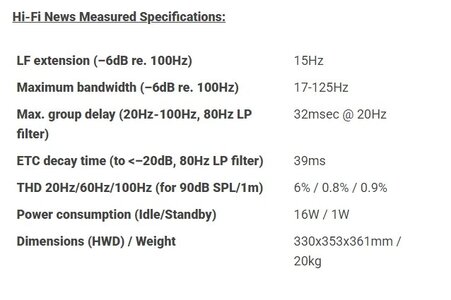
kef kc92 might sound good but look at the distortion number at 20hz at only 90db (rated at 11hz and 110db)


2026-01-31 11_48_48-Greenshot.jpg
 
kef kc92 might sound good but look at the distortion number at 20hz at only 90db (rated at 11hz and 110db)


View attachment 10904
Surely a typo......
 
Surely a typo......
I wondered the same, so I had to check this out, but sure enough a Perlisten sub at three times the price has 1.5% at 20Hz from the same magazine. Thinking about it, harmonics of 20Hz are 40Hz, 60Hz, 80Hz and so on, so in reality it will go unnoticed in the general rumbling, and actually that’s a gruelling test at 90dB. Twenty Hertz is very low indeed, and the territory of pipe organs and not much else!

KEF cleverly shape the LF output, as they show in the white paper about their smaller model. Rather like the Philips motional feedback circuits of years ago, they detect any overload and reduce the gain accordingly. Ultimately, this goes largely undetected by listening, but prevents white smoke!
 
Since updating all my audio and visual equipment save for the Audio Physic Classic 15 Floor-standers which I just love, I've been reading a lot and watching many videos regarding subs. I've always been a die hard 2 speaker only guy and getting them to sound as good as possible with ever changing Hi-Fi components. I guess I've always seen subs as a need for AV enthusiasts to get excited about rather than people interested in Hi-Fi.

I cant recall what got me looking into this, most likely a random video on YouTube suddenly finding its way onto my screen. The one I watched most recently was John Darko and his review of the KEF KC62 which I think was posted by him some years ago. I then started looking at the connections on the rear of my Naim Nova PE and see that it has dedicated outs for a sub.

I have never felt the speakers I have are lacking in bass but I'm now wondering what gains can be had from such a device and how easy it is to integrate into my system. It appears my view on them being slow, cumbersome pieces of equipment is from the dark ages and the modern units are alive, fast and agile.

Thoughts please.
Subs are NOT primarily about MORE bass. They can be used that way, to offer extension lacking in the main speakers, or output lacking in the main speakers.

But room acoustics research for decades has demonstrated that subs are about more accurate bass and counteracting room modes.

TLDR, the main speakers are seldom in the place where they interact well with room modes. Passing the lowest two octaves off to the subwoofers lets you position the subwoofers in locations that interact beneficially with each other and with room modes.

Unfortunately, if subwoofers are set up incorrectly (wrong locations, wrong phase, wrong time alignment, no bass management high pass/low pass filtering, etc) you will get boomy, smeared, inconsistent obnoxious bass, and that is what many people have experienced....so they give up on subwoofers instead of learning how to use them.
 
Some systems simply can correct 2 subs, the only have one sub out and no sub 2 sub sound the same when placement isn't the same + the size of the room
I was of the understanding that simply having one sub was the norm for an AV system as bass at that level is pretty much omnidirectional. Why then do people feel the need to add two in their set-up and how would you do it? Most amplifiers I know of that have a sub out function only have one.
 
I was of the understanding that simply having one sub was the norm for an AV system as bass at that level is pretty much omnidirectional. Why then do people feel the need to add two in their set-up and how would you do it? Most amplifiers I know of that have a sub out function only have one.
Multiple subs in an AV system is there for two purposes:

1) Increase SPL in the room, as the subwoofers will acoustically couple at low frequencies.

2) Tackle standing waves. The way that low frequencies work in a sealed room, you get peaks and dips at different frequencies, which cannot be EQ'd out. For example, one seat could be -6dB at 50Hz, but the very next seat could be absolutely fine. Move the sub, these peaks and dips simply shift in position, so something like the subwoofer crawl is not actually a great set up process when you're looking for even, linear bass across the listening area. Or even for one position, because there will always be some kind of problem at some frequencies at any given place in the room. By using multiple subs, you basically use the peaks of one to fill in the dips of the other(s) and vice versa with nulls cutting off peaks. All in an attempt to smooth out and homogenize the bass response throughout the room.

Out of all the currently offered on the website models of AVR across the Big Four - Denon, Marantz, Yamaha, Onkyo - only one model (the cheapest Yamaha) is a .1. Everything else is .2, with a smattering of .4s. Two sub outs has been very common for a while. But if you were to have that entry level Yamaha, you could simply use an RCA splitter, or a wireless solution that allows for multiple receivers to work off a single transmitter. You wouldn't have the individual delay control, but it's still better than having only one sub.

Multiple subs for home theatre is that important that you're better off getting two cheaper subs than one bigger one.
 
Multiple subs in an AV system is there for two purposes:

1) Increase SPL in the room, as the subwoofers will acoustically couple at low frequencies.

2) Tackle standing waves. The way that low frequencies work in a sealed room, you get peaks and dips at different frequencies, which cannot be EQ'd out. For example, one seat could be -6dB at 50Hz, but the very next seat could be absolutely fine. Move the sub, these peaks and dips simply shift in position, so something like the subwoofer crawl is not actually a great set up process when you're looking for even, linear bass across the listening area. Or even for one position, because there will always be some kind of problem at some frequencies at any given place in the room. By using multiple subs, you basically use the peaks of one to fill in the dips of the other(s) and vice versa with nulls cutting off peaks. All in an attempt to smooth out and homogenize the bass response throughout the room.

Out of all the currently offered on the website models of AVR across the Big Four - Denon, Marantz, Yamaha, Onkyo - only one model (the cheapest Yamaha) is a .1. Everything else is .2, with a smattering of .4s. Two sub outs has been very common for a while. But if you were to have that entry level Yamaha, you could simply use an RCA splitter, or a wireless solution that allows for multiple receivers to work off a single transmitter. You wouldn't have the individual delay control, but it's still better than having only one sub.

Multiple subs for home theatre is that important that you're better off getting two cheaper subs than one bigger one.
I always felt one decent sized sub suitably positioned was more than adequate for my AV set-up when I had one. More than one seems just a way to get you to spend more money
🙂
As this thread is regarding subs in HiFi, I was trying to establish why the same doesn't seem to apply when it comes to a stereo set-up even when most integrated amplifiers only have one sub out.
 
I always felt one decent sized sub suitably positioned was more than adequate for my AV set-up when I had one. More than one seems just a way to get you to spend more money
🙂
I was trying to establish why the same doesn't seem to apply when it comes to a stereo set-up even when most integrated amplifiers only have one sub out.
Unless you actually tried two subs in your setup, I guess you might come to the conclusion that it seemed suitable. But the physics is the physics - the experience of the low end would not be equal across the various listening positions in your space, and there will be some issues at your main listening position. And on the more money thing - as stated, I'd much rather buy two cheaper subs, and in my time as a retailer, would regularly recommend two subs at half the price each. I know many good dealers who do the same.

On the stereo side - most two channel systems are sitting in dual purpose rooms, and from experience it's hard enough to convince someone to put a single subwoofer in the living room. There is also the fact that, for home theatre a subwoofer is nigh on absolutely a necessity - after all, the LFE channel is a discrete channel in the same way that the centre, or front left/front right are all discrete channels. So there's an element of not adding cost for something that may get very little use.

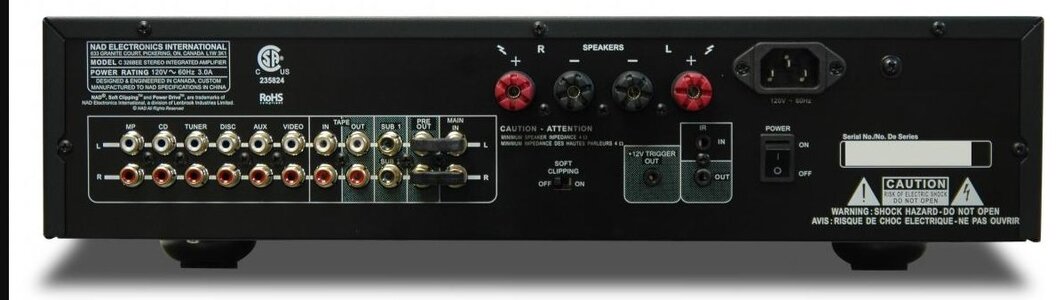
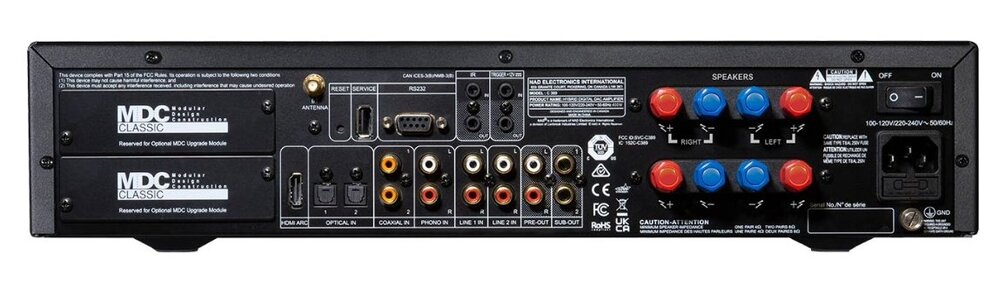
However, everything mentioned previously is still in play, not because of the format, but because it's just how low frequencies work in sealed spaces. Saying that, a lot of amplifiers do have preouts, which is an acceptable way of adding subs to a stereo system, and many subwoofers have speaker level inputs - also acceptable.
 

TRENDING THREADS

Latest posts