
DIY Headphone Amp #3 - Starving Student Hybrid
- Thread starter PJPro
- Start date
You are using an out of date browser. It may not display this or other websites correctly.
You should upgrade or use an alternative browser.
You should upgrade or use an alternative browser.

A
Anonymous
Guest
tractorboy:
Like: the shiny valves
Dislike: the curtain rail brackets
Yeah, I agree with you. I really wanted to do something with valves but was a bit worried about the high voltages usually involved. The Starving Student is a hybrid and was effectively designed to negate the need for high voltages by relying on integrated circuits to assist with the amplification. This particular variant is PCB based rather than point to point (P2P)and was designed by some of the posters on Headfi based on the Peter Millet original. I did consider the SOHA 2 but this Starvinbg student is a complete kit.
As for the heatsink, some love it others hate it. I'll reserve judgement for now. Clearly, it is easily replaced by a different style like this one....

Anyway, hopefully it'll make an for an interesting build and sound good too. With a bit of luck, I may even inspire someone else to have a go!
Like: the shiny valves
Dislike: the curtain rail brackets
Yeah, I agree with you. I really wanted to do something with valves but was a bit worried about the high voltages usually involved. The Starving Student is a hybrid and was effectively designed to negate the need for high voltages by relying on integrated circuits to assist with the amplification. This particular variant is PCB based rather than point to point (P2P)and was designed by some of the posters on Headfi based on the Peter Millet original. I did consider the SOHA 2 but this Starvinbg student is a complete kit.
As for the heatsink, some love it others hate it. I'll reserve judgement for now. Clearly, it is easily replaced by a different style like this one....
Anyway, hopefully it'll make an for an interesting build and sound good too. With a bit of luck, I may even inspire someone else to have a go!

idc
Well-known member
- Jan 2, 2008
- 1,169
- 142
- 19,370









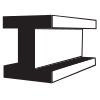





Hi PJ. Can't wait for the build to start. A little question, whether you can answer it now or will have to wait until the build is finished to answer it doesn't matter. The Starving Student has two valves and is a hybrid. The valves poke out of the top and there is a large heat sink on it. The Musical Fidelity X-CANS and V8P are also two valve hybrid amps. They come in metal boxes with similar finishes to that seen on the above photo with the ridges in the metal. Both X-CANS get warm during extended listening, but not hot. They do not get as hot as the Rega Mira amp. How hot do you expect the Starving Student to get? Any idea why it appears to need far more ventilation that the X-CANS?
Thanks.
Thanks.
A
Anonymous
Guest
Thanks Martyp.
I hope to show others that this DIY isn't too difficult. It adds a whole new dimension to Hifi. And it's much more satisfying listening to something you've made rather than just gone out and bought. You can get decent results for not much money, with not a lot of skill required.
I hope to show others that this DIY isn't too difficult. It adds a whole new dimension to Hifi. And it's much more satisfying listening to something you've made rather than just gone out and bought. You can get decent results for not much money, with not a lot of skill required.
idc
Well-known member
- Jan 2, 2008
- 1,169
- 142
- 19,370
PJPro:idc:I bet that if you build it rather than buy it it WILL sound better! Agreed. That's why I haven't majored too much on how my builds so far have sounded.
What does your present setup comprise of? I remember from other posts you are a bit if a headfier!
What does your present setup comprise of? I remember from other posts you are a bit if a headfier!
Err. I've finished this and listening to the amp now. I do have pictures and intend to write up the build. I won't be doing the full works like usual, however, as there is an excellent build thread already out there written by a guy called tomb. He's one of the developers of the kit. I can't post a link as I fear that I would be contravening the house rules.
Use the following search parameters in Google and I'm sure the right thread will be returned:
Starving Student Millett Hybrid PCB Step-By-Step Build Guide
First impressions? Good. Trebles are a bit harsh but I'd expect that to mellow over time.
I'm building up quite a collection of headamps. Expect a super test in the not too distance future using LPro's bat detecting but audiophobe ears.
Use the following search parameters in Google and I'm sure the right thread will be returned:
Starving Student Millett Hybrid PCB Step-By-Step Build Guide
First impressions? Good. Trebles are a bit harsh but I'd expect that to mellow over time.
I'm building up quite a collection of headamps. Expect a super test in the not too distance future using LPro's bat detecting but audiophobe ears.
idc
Well-known member
- Jan 2, 2008
- 1,169
- 142
- 19,370
PJPro:Err. I've finshed this and listening to the amp now. I do have pictures and intend to write up the build.
Looking forward to that

PJPro: I'm building up quite a collection of headamps. Expect a super test in the not too distance future using LPro's bat detecting but audiophobe ears.
Really looking forward to that
Looking forward to that
PJPro: I'm building up quite a collection of headamps. Expect a super test in the not too distance future using LPro's bat detecting but audiophobe ears.
Really looking forward to that
One of the tricky bits about building this amp is preparing the tube sockets. Please refer to the build thread mentioned above for details of how to do this. I used the same method and managed to separate the two halves of the socket without issue (so I've now got two spare!).
I glued to two halves back together again with Araldite. Seemed to work quite well but you do need to be careful not to get glue all over the metals bits. Once the glue had gone off I tried to fit a socket. Damn! It wouldn't fit! I happened to have some rather heavy duty resistors hanging about and used one of the leads from these to free up each of the metal receptacles into which the tube fits. After a bit of effort I managed to free things up but it's still a nice tight fit.
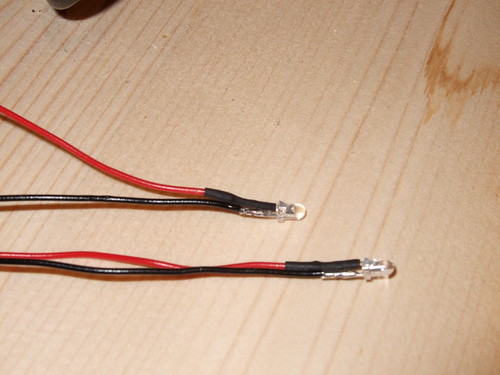
Prepared LEDs.
For the rest of it, I followed the build thread instructions and didn't encounter any problems. During the build you have to make a choice over the gain required. Initially, I went for the 50K resistors which gave me almost no movement on the volume pot before the music was unbearably loud. So, I swapped them out for the 100K resistors and all was fine.
You can see below the completed PCB which is attached to the lid of the case. The tubes poke up through the lid (you can't see them in this picture) and the MOSFETs are attached to the heatsinks.
It was a bit tricky getting the heatsinks on as the heatsink paste made everything a bit slippy. Also, the allen bolts require imperial keys (which I don't have). I ended up using finger pressure to tighten them.
If you look closely, you'll notice that the MOSFETs aren't actually soldered to the PCB yet! I was just about to do the soldering when I took this picture. You might also notice the insulating pads which insulate the MOSFETs from the case lid.
Oh, and those green capacitors are actually from the Nichicon Muse range. In fact all the components appear to be really good quality given the price of the kit.
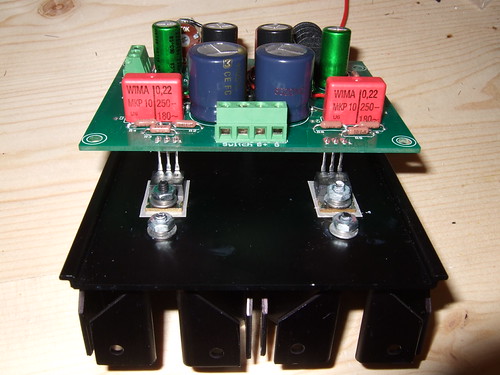
Soldering on the MOSFETs.
The next job was to fit the RCA sockets, power inlet and switch to the back panel and wire them in. Again, I used the heatshrink...makes for a really nice job. The power and switch leads are tightly wound together to reduce interference and the RCA signal cables are plaited using a Litz Braid.
You'll notice that the headphone socket and volume pot is soldered onto the board, so no messing about with wiring.
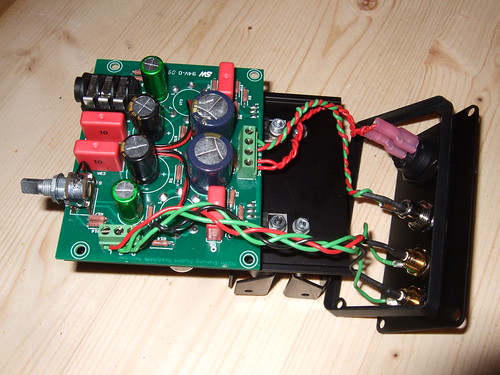
Wiring on the back panel.
Here's the final picture of the completed amp. I went with the rather ugly heatsinks to stay true to the design and, to be honest, hardly notice them now.
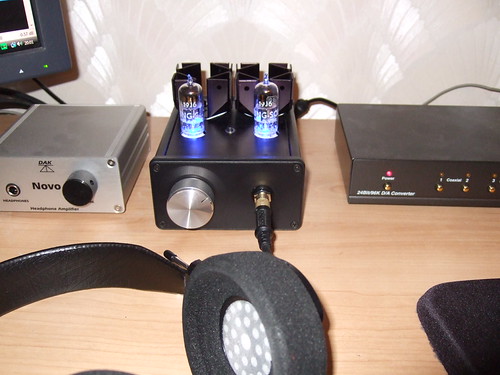
The amp has been played for about 50 hours. I sense a real improvement to the harshness of the treble but I might just be getting used to it. There's plenty of well disciplined bass and overall I'm pleased with the performance.
Would I recommend this kit to someone? Absolutely. Unfortunately, they are sold out and may not be available in the future. However, the Starving Student as a design lives on and as an introduction to building valves amps, without the high voltages, it comes highly recommended.
I glued to two halves back together again with Araldite. Seemed to work quite well but you do need to be careful not to get glue all over the metals bits. Once the glue had gone off I tried to fit a socket. Damn! It wouldn't fit! I happened to have some rather heavy duty resistors hanging about and used one of the leads from these to free up each of the metal receptacles into which the tube fits. After a bit of effort I managed to free things up but it's still a nice tight fit.
Prepared LEDs.
For the rest of it, I followed the build thread instructions and didn't encounter any problems. During the build you have to make a choice over the gain required. Initially, I went for the 50K resistors which gave me almost no movement on the volume pot before the music was unbearably loud. So, I swapped them out for the 100K resistors and all was fine.
You can see below the completed PCB which is attached to the lid of the case. The tubes poke up through the lid (you can't see them in this picture) and the MOSFETs are attached to the heatsinks.
It was a bit tricky getting the heatsinks on as the heatsink paste made everything a bit slippy. Also, the allen bolts require imperial keys (which I don't have). I ended up using finger pressure to tighten them.
If you look closely, you'll notice that the MOSFETs aren't actually soldered to the PCB yet! I was just about to do the soldering when I took this picture. You might also notice the insulating pads which insulate the MOSFETs from the case lid.
Oh, and those green capacitors are actually from the Nichicon Muse range. In fact all the components appear to be really good quality given the price of the kit.
Soldering on the MOSFETs.
The next job was to fit the RCA sockets, power inlet and switch to the back panel and wire them in. Again, I used the heatshrink...makes for a really nice job. The power and switch leads are tightly wound together to reduce interference and the RCA signal cables are plaited using a Litz Braid.
You'll notice that the headphone socket and volume pot is soldered onto the board, so no messing about with wiring.
Wiring on the back panel.
Here's the final picture of the completed amp. I went with the rather ugly heatsinks to stay true to the design and, to be honest, hardly notice them now.
The amp has been played for about 50 hours. I sense a real improvement to the harshness of the treble but I might just be getting used to it. There's plenty of well disciplined bass and overall I'm pleased with the performance.
Would I recommend this kit to someone? Absolutely. Unfortunately, they are sold out and may not be available in the future. However, the Starving Student as a design lives on and as an introduction to building valves amps, without the high voltages, it comes highly recommended.
A
Anonymous
Guest
Similar threads
- Replies
- 8
- Views
- 461


- Replies
- 9
- Views
- 2K

- Replies
- 198
- Views
- 16K


TRENDING THREADS
-

-

-

-
 Argon TT4 out, Thorens TD403DD in (?) Please, help!
- Started by freddyonderstal
- Replies: 12
-

-

-



Space.com is part of Future plc, an international media group and leading digital publisher. Visit our corporate site.
© Future Publishing Limited Quay House, The Ambury, Bath BA1 1UA. All rights reserved. England and Wales company registration number 2008885.
 Facebook
 Twitter
 Instagram