Appreciating you system

Page 2 - Seeking answers? Join the What HiFi community: the world's leading independent guide to buying and owning hi-fi and home entertainment products.
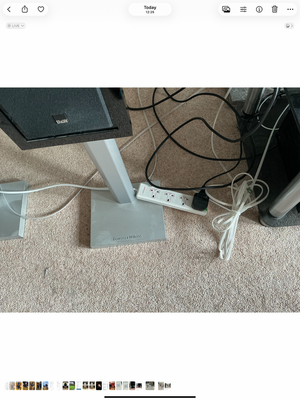
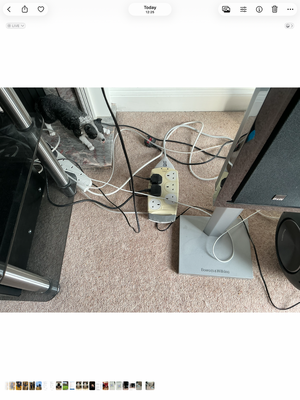
Just had a tidy up now I have only got one attached. 🙂
You know, I'm really glad I brought this up, and thank you @froze for highlighting the electrical hazards and this had me checking back on my wiring and I have inadvertently daisy chained my Tacima with another surged protection extension socket!

I have to re-cable again, safety always comes first!
 
  • Like
Reactions: Al ears and Gel Man
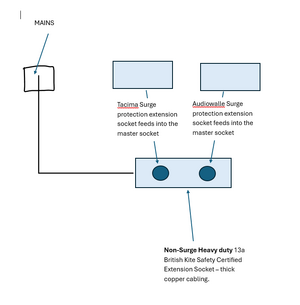
This is how I'm going to re-cable my wiring in the study.

1770645956689.png

Ps.
Ideally, each surge protection extension socket for each wall mains outlet. I don't have everything on at the same time, fingers crossed!
 
Last edited:
  • Like
Reactions: Gel Man
This is them:
TrippLite does make a surge protector called Isobar Ultrablok heavy duty outlet extender. This thing plugs into the outlet, but there is NO extension cord, you simply plug in your component power cords directly into the outlet extender. This will help you tidy up some of the cords you have, and since there is no extension cord, it can help to reduce component heat a bit. This is an outlet looking device so there is only room for 2 plugs to go into it just like a wall outlet.

Those plastic ones that you are using are not that effective, they may be ranked with what appears to be high surge ratings but they are inexpensive and don't work as well as they advertise. Steel cased surge protectors, like the Tripplit line of Isobar protectors are designed to take a huge hit of heat that will melt plastic ones and cause a fire.

Just a single lightning bolt can carry anywhere from 100 million to 1 billion volts of electricity. This astronomical amount of energy that completely overwhelms even the most robust consumer-grade surge protectors, rendering them effectively useless against a direct or nearby lightning strike.

This is what happens when lightning strikes a home.
The surge may completely bypass the surge protection circuitry due to its speed and intensity. The protective components may instantly fail, creating an unimpeded path for electricity. The surge protector itself may overheat, melt, or even catch fire. The excess energy may jump (arc) across components, defeating the protection mechanisms, even if you have the power switch off!!

That is why I said in an earlier comment, that you need to unplug valuable components if you know a severe thunderstorm is coming and you can hear it booming in the distance. While a direct hit to a home is rare, it does happen, or it could hit a power line near your house and send all that juice to several homes. This means that if you are going to be gone for a while and you'll be gone during thunderstorm season, it's wise to just unplug everything valuable while you are gone.

Sure, you might have homeowners' insurance to cover such an event, but you'll have deductible to meet. In my case I don't like giving insurance companies my money, and I have a lot of properties and cars, separate liability insurance, so all my properties have the max deductible that the insurance company has, which in my case is $2,500 to keep my overall premiums as low as possible.

Speaking of things that don't work well, the warranties that surge protection companies put on their protectors are not all that good, you would be very lucky if you had a surge and stuff got damaged, that the surge protection company will pay out! The cheaper the protector is the more impossible it will become to collect a dime from them. They have a lot of rules that must be proven that you followed, you have to read those rules and comply to using the surge protector exactly per their instructions. Some will say a lifetime warranty but if you read the fine print, the lifetime means the life of the surge protector, not your life, and they predetermine their unit's life, most are 3 to 10 years. Of course, you need to save the original box and receipt, believe it or not most if not, all companies want the original box which they know most people will throw away and that will void the warranty claim.

My home stereo system is plugged into a 30-year-old Panamax 1000, this thing is now past its designed lifetime, so their warranty will no longer apply, but I still use it, why? Because I have a friend who is an electronics savant and I took the Panamax to him to see if it was still any good, he ran tests on it and told me the thing was still good and working as designed. Plus, I also have a whole house surge protector in the breaker box, so I'm not worried about it. He told me that unless a major surge comes through, short of a direct lightning strike, that thing will be good for a very long time. That is an example however of a surge protection company only wanting to be on the risk for a short time and not be on the risk for 50 years. Electronics do wear out over time thus companies don't want to be responsible for stuff wearing out, but so far that Panamax is good, though my 30-year-old Harman Kardon PA2400 amp had to be somewhat rebuilt this last year due to some of the electronics wearing out. But surge protectors are not a cluster falk of electronics like an amp is, usually more simplistic designs last longer.

 
  • Like
Reactions: Jasonovich
TrippLite does make a surge protector called Isobar Ultrablok heavy duty outlet extender. This thing plugs into the outlet, but there is NO extension cord, you simply plug in your component power cords directly into the outlet extender. This will help you tidy up some of the cords you have, and since there is no extension cord, it can help to reduce component heat a bit. This is an outlet looking device so there is only room for 2 plugs to go into it just like a wall outlet.

Those plastic ones that you are using are not that effective, they may be ranked with what appears to be high surge ratings but they are inexpensive and don't work as well as they advertise. Steel cased surge protectors, like the Tripplit line of Isobar protectors are designed to take a huge hit of heat that will melt plastic ones and cause a fire.

Just a single lightning bolt can carry anywhere from 100 million to 1 billion volts of electricity. This astronomical amount of energy that completely overwhelms even the most robust consumer-grade surge protectors, rendering them effectively useless against a direct or nearby lightning strike.

This is what happens when lightning strikes a home.
The surge may completely bypass the surge protection circuitry due to its speed and intensity. The protective components may instantly fail, creating an unimpeded path for electricity. The surge protector itself may overheat, melt, or even catch fire. The excess energy may jump (arc) across components, defeating the protection mechanisms, even if you have the power switch off!!

That is why I said in an earlier comment, that you need to unplug valuable components if you know a severe thunderstorm is coming and you can hear it booming in the distance. While a direct hit to a home is rare, it does happen, or it could hit a power line near your house and send all that juice to several homes. This means that if you are going to be gone for a while and you'll be gone during thunderstorm season, it's wise to just unplug everything valuable while you are gone.

Sure, you might have homeowners' insurance to cover such an event, but you'll have deductible to meet. In my case I don't like giving insurance companies my money, and I have a lot of properties and cars, separate liability insurance, so all my properties have the max deductible that the insurance company has, which in my case is $2,500 to keep my overall premiums as low as possible.

Speaking of things that don't work well, the warranties that surge protection companies put on their protectors are not all that good, you would be very lucky if you had a surge and stuff got damaged, that the surge protection company will pay out! The cheaper the protector is the more impossible it will become to collect a dime from them. They have a lot of rules that must be proven that you followed, you have to read those rules and comply to using the surge protector exactly per their instructions. Some will say a lifetime warranty but if you read the fine print, the lifetime means the life of the surge protector, not your life, and they predetermine their unit's life, most are 3 to 10 years. Of course, you need to save the original box and receipt, believe it or not most if not, all companies want the original box which they know most people will throw away and that will void the warranty claim.

My home stereo system is plugged into a 30-year-old Panamax 1000, this thing is now past its designed lifetime, so their warranty will no longer apply, but I still use it, why? Because I have a friend who is an electronics savant and I took the Panamax to him to see if it was still any good, he ran tests on it and told me the thing was still good and working as designed. Plus, I also have a whole house surge protector in the breaker box, so I'm not worried about it. He told me that unless a major surge comes through, short of a direct lightning strike, that thing will be good for a very long time. That is an example however of a surge protection company only wanting to be on the risk for a short time and not be on the risk for 50 years. Electronics do wear out over time thus companies don't want to be responsible for stuff wearing out, but so far that Panamax is good, though my 30-year-old Harman Kardon PA2400 amp had to be somewhat rebuilt this last year due to some of the electronics wearing out. But surge protectors are not a cluster falk of electronics like an amp is, usually more simplistic designs last longer.
My kit is barely worth anything now if worse comes to worse I will just replace it. I don’t feel the need to go that dramatic about it. Thanks
 
TrippLite does make a surge protector called Isobar Ultrablok heavy duty outlet extender. This thing plugs into the outlet, but there is NO extension cord, you simply plug in your component power cords directly into the outlet extender. This will help you tidy up some of the cords you have, and since there is no extension cord, it can help to reduce component heat a bit. This is an outlet looking device so there is only room for 2 plugs to go into it just like a wall outlet.

Those plastic ones that you are using are not that effective, they may be ranked with what appears to be high surge ratings but they are inexpensive and don't work as well as they advertise. Steel cased surge protectors, like the Tripplit line of Isobar protectors are designed to take a huge hit of heat that will melt plastic ones and cause a fire.

Just a single lightning bolt can carry anywhere from 100 million to 1 billion volts of electricity. This astronomical amount of energy that completely overwhelms even the most robust consumer-grade surge protectors, rendering them effectively useless against a direct or nearby lightning strike.

This is what happens when lightning strikes a home.
The surge may completely bypass the surge protection circuitry due to its speed and intensity. The protective components may instantly fail, creating an unimpeded path for electricity. The surge protector itself may overheat, melt, or even catch fire. The excess energy may jump (arc) across components, defeating the protection mechanisms, even if you have the power switch off!!

That is why I said in an earlier comment, that you need to unplug valuable components if you know a severe thunderstorm is coming and you can hear it booming in the distance. While a direct hit to a home is rare, it does happen, or it could hit a power line near your house and send all that juice to several homes. This means that if you are going to be gone for a while and you'll be gone during thunderstorm season, it's wise to just unplug everything valuable while you are gone.

Sure, you might have homeowners' insurance to cover such an event, but you'll have deductible to meet. In my case I don't like giving insurance companies my money, and I have a lot of properties and cars, separate liability insurance, so all my properties have the max deductible that the insurance company has, which in my case is $2,500 to keep my overall premiums as low as possible.

Speaking of things that don't work well, the warranties that surge protection companies put on their protectors are not all that good, you would be very lucky if you had a surge and stuff got damaged, that the surge protection company will pay out! The cheaper the protector is the more impossible it will become to collect a dime from them. They have a lot of rules that must be proven that you followed, you have to read those rules and comply to using the surge protector exactly per their instructions. Some will say a lifetime warranty but if you read the fine print, the lifetime means the life of the surge protector, not your life, and they predetermine their unit's life, most are 3 to 10 years. Of course, you need to save the original box and receipt, believe it or not most if not, all companies want the original box which they know most people will throw away and that will void the warranty claim.

My home stereo system is plugged into a 30-year-old Panamax 1000, this thing is now past its designed lifetime, so their warranty will no longer apply, but I still use it, why? Because I have a friend who is an electronics savant and I took the Panamax to him to see if it was still any good, he ran tests on it and told me the thing was still good and working as designed. Plus, I also have a whole house surge protector in the breaker box, so I'm not worried about it. He told me that unless a major surge comes through, short of a direct lightning strike, that thing will be good for a very long time. That is an example however of a surge protection company only wanting to be on the risk for a short time and not be on the risk for 50 years. Electronics do wear out over time thus companies don't want to be responsible for stuff wearing out, but so far that Panamax is good, though my 30-year-old Harman Kardon PA2400 amp had to be somewhat rebuilt this last year due to some of the electronics wearing out. But surge protectors are not a cluster falk of electronics like an amp is, usually more simplistic designs last longer.

I take it you are in the US, whereas most on this forum are from the UK/Europe where laws are way stricter when it comes to electrical items due to the fact that we run on 220V, also if claims by manufactures are made and it is found to be incorrect then various regularity body's would become involved which could mean fines for the manufacture.

In addition the electrical system is more stable than the US as everything is not spread out as much.
Electrical storms like you have in the US are also very rare.
Insurance premiums over here are also usually about a tenth of what they are in the US as the industry is way more regulated.
As to the other parts of your post, you make really valid observations.

Bill
 
  • Like
Reactions: Al ears
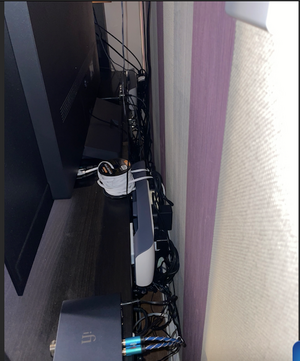
My new Belkin surge rotecters arrived today ive been puting this of for years .The back of my set up was a real mess of 14 power cables HDMIs RCAs and opticals .2 hours to reroute and tidy not fun all done now i do feel better it all works .

should have taken a picture when it was out this is it now
 

Attachments

  • belkin.png
    belkin.png
    436.5 KB · Views: 5

TRENDING THREADS

Latest posts